SOUTH CHINA SEA NAVAL COOPERATION
SINGAPORE - BY ASIA INSIDER - Apr 13,2024
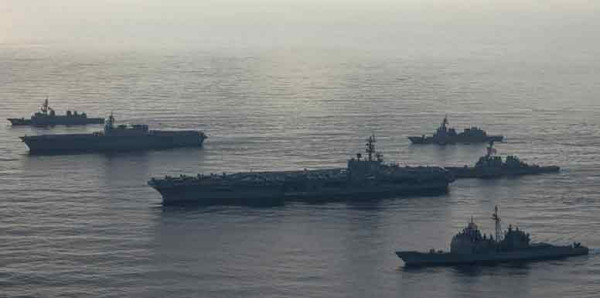
The latest Maritime Cooperative Activity (MCA) exercise in the South China Sea commenced on April 7, 2024, featuring naval units from Australia, Japan, the Philippines, and the United States. A joint statement, released on April 6 by the Philippine Department of National Defense (DND), emphasized adherence to international and domestic laws during the exercise, with due consideration for navigation safety and the rights of other states. Defense secretaries/ministers from the four nations signed the statement, marking a commitment to cooperative maritime practices.
This marks the fourth MCA exercise in 2024, building on previous collaborations between the US and Philippine navies, as well as the Australian and Philippine navies. Notable participants in the latest exercise included the BRP Gregorio del Pilar and Ramon Alcaraz from the Philippines, the USS Mobile from the United States, the JS Akebono from Japan, and the HMAS Warramunga from Australia.
The Japanese Embassy in the Philippines provided additional details on the exercise scenarios, which encompassed anti-submarine warfare training, tactical exercises, link exercises, and photo exercises. Concurrently, the People’s Liberation Army (PLA) Southern Theater Command (STC) announced joint naval and air patrols in the South China Sea on the same day, asserting control over military activities in the region.
These exercises come amidst heightened tensions between Beijing and Manila, with reports of Chinese Coast Guard ships harassing Filipino vessels in Philippine Exclusive Economic Zone (EEZ) waters. The Philippine Coast Guard reported incidents of harassment near Rozul Reef, highlighting ongoing maritime disputes in the area.
In parallel, discussions are underway to deepen defense cooperation between Manila and Tokyo, following a summit involving Manila, Tokyo, and Washington DC scheduled for April 11. Proposed topics include establishing a legal framework for the rotational deployment of Japanese Self-Defense Forces (JSDF) on Philippine territory, potentially under a Japan-Philippines Reciprocal Access Agreement (RAA).
This agreement would expand existing security partnerships, aligning with similar arrangements with the United States and Australia. Additionally, talks may explore JSDF participation in joint exercises like Balikatan and maritime patrols in the South China Sea.
For Japan, participation in the MCA reflects a broader strategic shift amid regional security challenges posed by Russia, China, and North Korea. By enhancing its presence in the Indo-Pacific, Japan aims to strengthen its reputation as a reliable security partner.
Meanwhile, the Philippines seeks to counter Chinese incursions into its waters through alliances with like-minded countries. Engagement in the MCA underscores Manila's commitment to upholding maritime law in Southeast Asia, particularly in the South China Sea.
Overall, the MCA exercises serve to assert navigation rights in international waters while deepening military cooperation among allied nations. The trilateral summit offers an opportunity for the United States to bolster its presence in the Indo-Pacific, contributing to regional stability and security.